


Green Rooibos – Aroma, Taste and Quality
From dried grass and oats to honey and caramel: exploring the sensory character of green rooibos.
What does green rooibos taste like? Its aroma profile ranges from hay, dried grass and cooked oats to woody notes and aromas reminiscent of honey or caramel. When drinking it, you may also notice sweetness, bitterness and a slightly dry, puckering sensation in the mouth. The prominence of these characteristics varies from batch to batch.
There is more to this varied profile than the simple description ‘grassy’. A South African research team therefore carried out a systematic sensory study of green rooibos. Their findings help us recognise characteristic aromas and understand differences between teas from different producers.
What makes green rooibos different?
Green and red rooibos come from the same plant, Aspalathus linearis. In green rooibos, rapid processing and drying limit the extensive enzymatic oxidation of the harvested plant material. As a result, its colour and plant compounds differ from those of traditionally oxidised red rooibos.
However, ‘green’ primarily describes the processing method, not a fixed colour. Dried green rooibos can appear greenish, grey-green or partly brown. Colour alone is therefore not a reliable measure of flavour or plant-compound content.
The key distinction: Green rooibos is not simply red rooibos with a different leaf colour. The way it is processed gives it a distinctive aroma and flavour profile.
How researchers studied the flavour of green rooibos
Researchers from Stellenbosch University and South Africa's Agricultural Research Council studied 57 batches of green rooibos from two producers over five production years. Trained assessors described the infusions using a consistent sensory vocabulary. The research produced two sensory wheels: an aroma wheel for what we smell, and a palate wheel for what we perceive while drinking.
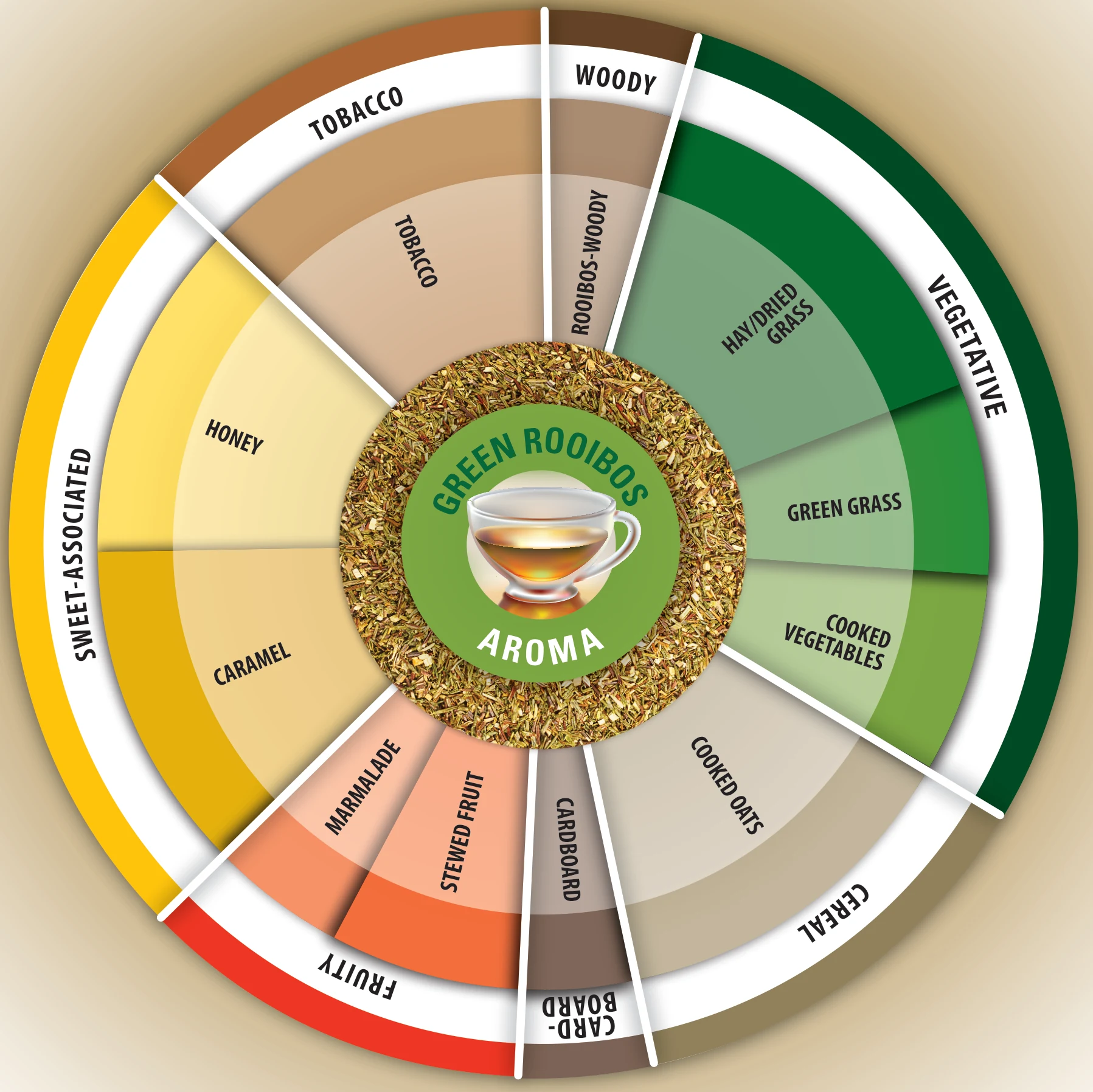
The findings are revealing. Alongside hay, dried grass and cooked oats, honey, caramel and tobacco-like notes were among the more prominent aromas. Fresh grass, cooked vegetables, stewed fruit and marmalade were also identified, but were less intense across the samples studied.
The wheels are neither recipes nor rankings of individual chemical constituents. They show how the assessors perceived the infusions they examined. The varying widths of the segments reflect the intensity of the recorded impressions within that particular sample group.
Research source: de Beer et al. (2024), Development of sensory tools for green rooibos and changes in quality attributes during shelf-life storage. The Agricultural Research Council provides background on the original sensory wheels.
From dried grass to honey: the characteristic aroma notes
The research helps put familiar impressions into words. These descriptors refer to similarities with recognisable smells; they do not mean that rooibos contains the foods or substances mentioned.
| Aroma note | What does it resemble? | How to interpret it |
|---|---|---|
| Hay and dried grass | Dried grasses, warm hay | The most intense characteristic aroma in the samples studied. |
| Cooked oats | Porridge, warm cereals | A defining note that challenges many expectations of what a ‘green tea’ should taste like. |
| Tobacco-like | Dried tobacco leaves, with hints of hay, dried fruit and caramel | A sensory description, not an indication that rooibos contains tobacco or nicotine. |
| Honey and caramel | Warm aromas associated with sweetness | Among the prominent aromatic characteristics of green rooibos too. |
| Fresh grass and vegetables | Freshly cut grass, cooked green vegetables | Other characteristic vegetal notes, generally less intense. |
| Stewed fruit and marmalade | Cooked fruit, fruit preserves | Subtler fruity notes that may be more apparent in some cups than others. |
Which aroma dominates can vary between batches. The wheel is therefore not a rigid ideal that every green rooibos must match exactly.
What we smell, taste and feel in the mouth
In everyday conversation, we often call all these sensations ‘taste’. In scientific sensory assessment, they are considered separately. The second research wheel – the palate wheel – helps make these differences clear.
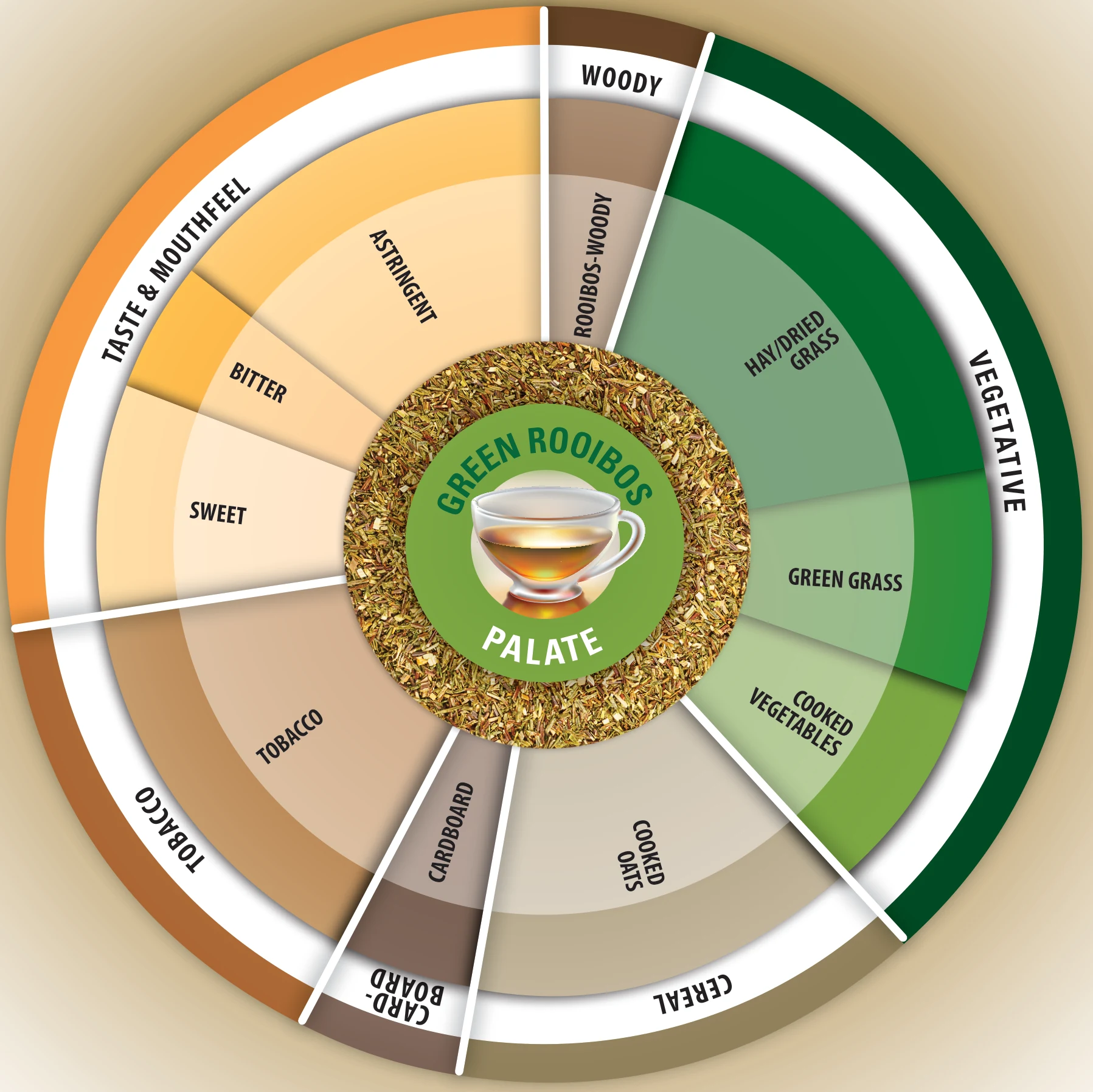
Aroma
What we smell: for example, honey, caramel, hay or cooked oats.
Taste
What we perceive on the tongue: in green rooibos, this includes sweet and bitter tastes.
Mouthfeel
How the infusion feels, for example slightly dry or puckering. This sensation is known as astringency.
Across the 57 rooibos batches examined, astringency was a clearly pronounced characteristic. Sweetness was also recorded and was more pronounced than bitterness. This does not mean every green rooibos must taste sweet, but it does establish sweetness as part of its scientifically described sensory range.
Green rooibos also has honey- and caramel-like aromas
Green rooibos is often associated with grassy aromas and a slightly astringent mouthfeel. Scientific sensory studies show, however, that honey and caramel aromas are also part of its natural aromatic profile.
How strongly these aromas come through can depend on the plant material, processing and preparation. One green rooibos may taste more grassy, while another allows its softer, sweet-associated notes to stand out.
It is particularly interesting that these aromas are already present in green rooibos. They cannot, therefore, be attributed solely to the extensive oxidation involved in making red rooibos.
Our knowledge page Flavour Profile, Cut Grades & Quality explains why rooibos can seem naturally sweet even though an unsweetened infusion contains virtually no sugar.
Are grassy notes or slight astringency a sign of poor quality?
No, not necessarily. Hay and grass notes are characteristic of green rooibos. If you know red rooibos mainly for its soft, woody and honey-like aromas, green rooibos may initially seem much more vegetal.
That does not mean a particularly strong grassy note automatically signals higher quality. What matters is whether the overall profile seems clear and harmonious. Personal preference also plays a part: some people enjoy pronounced green, grassy notes, while others prefer an infusion in which warmer, sweet-associated aromas are more noticeable.
Which impressions may suggest a quality problem?
The scientific aroma wheel distinguishes characteristic aromas from undesirable impressions that may, for example, arise through unfavourable processing or storage. These include musty or mouldy, rotting-plant-water, medicinal and unusually dusty notes.
An unusual smell on its own does not establish its cause. Sensory descriptions do, however, provide a useful starting point for identifying and investigating potential problems.
Why doesn't every green rooibos taste the same?
The aroma of green rooibos can vary considerably from one batch to another. Even with the same plant species and a similar processing approach, grassy, cereal-like and sweet-associated notes need not be equally pronounced. Studying different batches helps make this sensory diversity easier to understand.
To assess a rooibos, it is worth asking questions that lead directly to the producer's work: What plant material was harvested? How was it cut and handled after harvest? How quickly was it dried? And how was the finished rooibos stored?
When tasting different green rooibos teas side by side, you may find that grassy notes dominate in one, while honey, caramel or cereal-like notes are more noticeable in another. Research-based sensory vocabulary helps describe these distinctions without hastily turning them into a ranking of quality.
With South African producer brands such as Skimmelberg and Ouhuis, we want to introduce not only the finished tea but also the people and processing methods behind it. Sensory research gives us another way to explore their individual rooibos profiles.
How does storage affect colour and aroma?
Storage can change both the colour and aroma profile of green rooibos. The moisture permeability of the packaging and the storage temperature are particularly important. In the second part of the South African study, researchers compared different packaging materials and temperatures over 24 weeks, including 25 °C and 40 °C at 60 % relative humidity.
In moisture-permeable packaging, the plant material absorbed water from the surrounding air. Under these conditions, chlorophyll and certain polyphenols, including dihydrochalcones, changed. The aroma profile shifted as well: some vegetal and cereal-like impressions became less prominent, while sweet-associated and fruity notes were sometimes perceived more strongly.
A seemingly sweeter aroma therefore does not necessarily mean that the rooibos has ‘matured’ and improved during storage. It may instead reflect a change from its original characteristic profile.
Research finding: To preserve the colour, polyphenol profile and characteristic sensory qualities of green rooibos, the researchers recommend moisture-resistant packaging and storage temperatures no higher than 25 °C.
For storage at home, the practical rule is simple: keep green rooibos dry, well sealed and protected from heat.
Compare green rooibos yourself: a simple tasting exercise
You do not need to be a trained sensory assessor to notice differences between two green rooibos teas. The key is to prepare both under as nearly identical conditions as possible.
- Use the same quantities: Use the same amount of rooibos and water for each sample, for example 2.5 g per 200 ml.
- Brew them the same way: Pour on freshly boiled water and leave both infusions to steep for about five minutes.
- Smell first: Does the aroma remind you more of hay, fresh grass, oats, honey or caramel?
- Then taste: What do you notice on your tongue? Does the tea taste sweet or bitter? Does it feel dry or astringent in the mouth?
- Describe before judging: Note the differences without deciding which is better. Only then choose the green rooibos you prefer.
In this way, a seemingly simple cup of rooibos becomes a small journey into South Africa's world of plants and aromas.
Scientific sources and further reading
- De Beer, D. et al. (2024): Development of sensory tools for green rooibos and changes in quality attributes during shelf-life storage. Journal of the Science of Food and Agriculture, 104, 7567–7579.
- Agricultural Research Council: Sensory wheels for rooibos and honeybush tea – background and original tools for sensory assessment.
- Du Preez, B. V. P. et al. (2020): Rooibos Sensory Lexicon – An Illustrated Guide. Stellenbosch University / Agricultural Research Council.
- South African Rooibos Council: Frequently Asked Questions – Typical Nutritional Information.