



Flavour Profile, Cut Grades and Quality in Rooibos
Anyone who looks a little more closely at rooibos quickly notices one thing: rooibos does not always taste the same. Some teas feel soft and rounded, others fuller, drier or more robust. Some blends seem especially harmonious, others clearer or more direct. These differences can often be perceived quite easily, but they are not always easy to put into words.
This page helps place rooibos more clearly in terms of flavour. It shows which aromas are typical, which impressions are generally seen as less successful, and which factors make rooibos taste different from one product to another.
How rooibos typically tastes
Many people first associate rooibos with a mild, red, uncomplicated tea. That is not wrong, but it does not tell the whole story. Rooibos can feel soft and slightly sweet, but also warm, spicy, fruity or gently bitter. Depending on how it was processed, how fine or coarse the cut is, and whether it is drunk pure or as a blend, the flavour impression can change quite noticeably.
That is why there is no single rooibos flavour. Instead, rooibos moves within a flavour range of its own, stretching from soft, rounded and honey-like impressions to fuller, drier and more distinctive profiles.
Typical positive flavour directions in rooibos
- Honey-like: soft, mild, rounded and lightly sweet
- Caramel-like: warm, full and gently integrated
- Fruity: more soft and ripe than sharp or acidic
- Floral: light, delicate and sometimes reminiscent of fynbos
- Herbal: fine, natural plant notes with a little depth
- Warm and woody: typically rooibos, calm, distinctive and sometimes slightly dry in the mouthfeel
It is precisely this combination of warmth, softness and natural individuality that makes rooibos so special in flavour. It rarely feels loud or aggressive, but rather rounded and balanced. That is also why it works so well in blends with herbs, spices, flowers or fruits.
Which impressions tend to speak against a well-balanced rooibos
Not every strong note is automatically a sign of quality. Rooibos is often at its most convincing when its aromas feel clear, clean and well balanced. Less desirable are impressions that seem musty, dusty, burnt-caramel-like, medicinal or unpleasantly dull. Very green, hay-like or stale-watery notes also often do not fit a rounded rooibos profile.
Even small deviations can make a rooibos feel less clear, less clean or simply less pleasant overall.
- Musty: dull, not very fresh, slightly stale
- Dusty: dry, flat and lacking liveliness
- Burnt caramel-like: reminiscent of burnt sugar or burnt caramel, and therefore too dark or too harsh
- Medicinal: alien, artificial or disharmonious
- Hay-like or too green: unripe or unbalanced
- Stale and watery: unclean and disturbing in flavour
Why rooibos does not always taste the same
The flavour of rooibos does not arise by chance. It is the result of several steps working together. These include the cut grade, the way it is prepared, the origin of the rooibos, its location, and the processing after harvest. Fermentation also has a strong influence on the final impression in the cup. Added to this is the signature of the people who turn the harvested rooibos into a specific product.
As with wine, the final character of rooibos does not come from just one single factor. Site, preparation and processing all interact. That is why the same plant does not always result in the same tea, but in a remarkably broad range of possible outcomes.
Cut grades and grading in rooibos
One point that is often underestimated is the cut grade. Rooibos is processed in different cut lengths and particle sizes. In this context, terms such as grading or sorting are also often used. The cut grade is not only important for further processing, but also influences how rooibos is perceived in the cup.
In the rooibos sector, you come across various terms for cut grades and sorting styles. These include, for example:
- Short Cut
- Long Cut
- Choice
- Fine Cut
- Classic
- Extra Fine Cut
- Green Rooibos Fine Cut
- Green Rooibos Loose Leaf
Such terms help describe rooibos more precisely in terms of its physical preparation. What matters here is this: the cut grade is a relevant quality and processing feature, but it is not a simple ranking from bad to good.
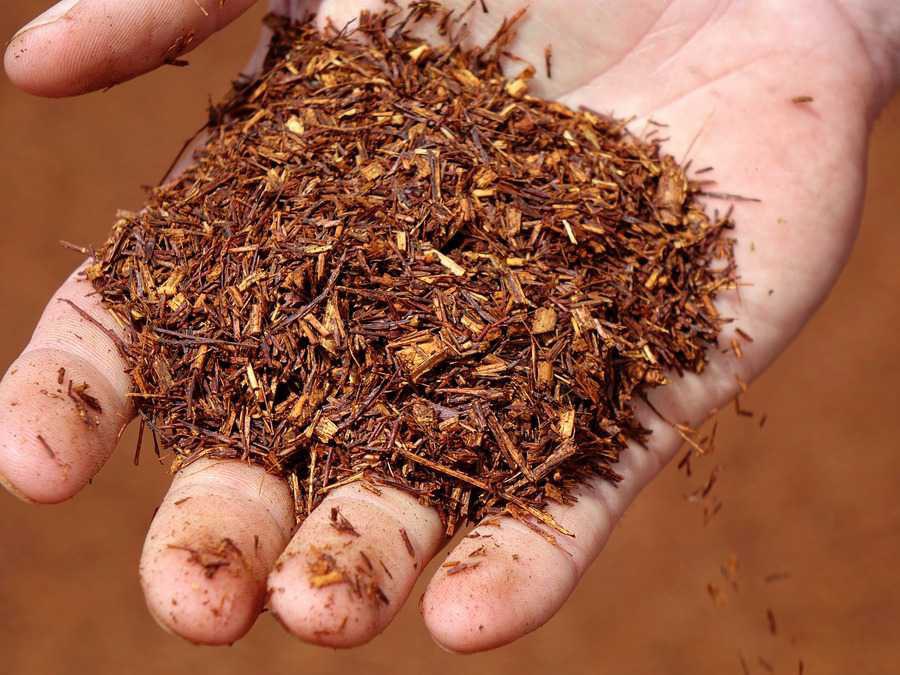
A finer cut is not automatically better than a coarser one. Rather, the character of the rooibos changes. Coarser grades often feel softer, sweeter and more traditional, while finer grades tend to appear more intense, denser and more distinctive.
Why coarse and fine cuts taste different
More coarsely cut rooibos often tastes softer, sweeter and calmer. Finer particle sizes, by contrast, usually produce a stronger aroma and tend to show more bitterness or astringency. The tea then feels denser, more intense and sometimes slightly drier.
This helps explain why two rooibos teas can feel different even when their basic idea is quite similar.
How quality is assessed in rooibos
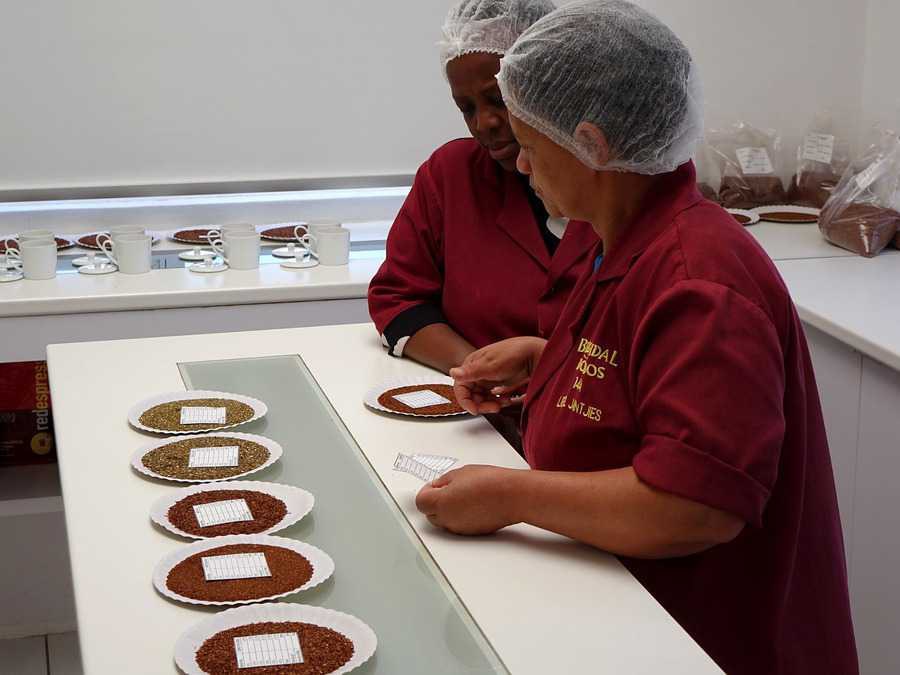
The flavour profile of a rooibos is important, but it is not the only quality feature. In practice, rooibos is first checked after drying and before further processing for key characteristics. These include, among other things, dry leaf colour, flavour and the later colour in the cup.
Later on, rooibos is also sorted according to length, colour, aroma and flavour. Quality is therefore always a combination of sensory impression, preparation and the consistency of the material. The proportion of stems or broken leaf also influences how a rooibos is assessed.
Quality grades and sorting
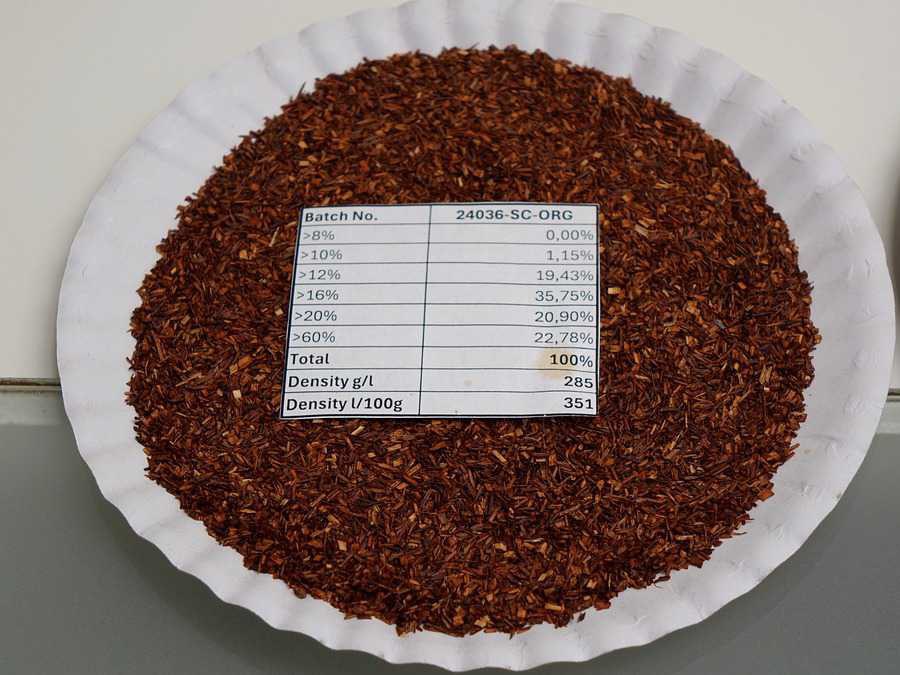
After further processing, rooibos is graded, meaning it is divided into quality grades. Common terms include Superior Grade, Choice Grade, Standard Grade and Industrial Grade.
- Superior Grade: long, even needles, an intense red-brown colour, a full rounded aroma and only very small amounts of stems or residual material
- Choice Grade: somewhat shorter leaves, slightly more stems, good colour and a pleasant, though usually somewhat less intense, flavour
- Standard Grade: a higher proportion of shorter stems and broken pieces, less even colour intensity and a generally less pronounced aroma
- Industrial Grade: clearly more stems and broken leaf, a milder aromatic profile and often used for industrial applications or lower-priced blends
Such grades help to understand rooibos not only sensorially, but also in terms of its sorting and preparation.
How preparation influences flavour
It is not only origin, processing and cut grade that shape rooibos. Preparation also influences how the tea feels in the cup. Even small differences in water temperature, steeping time and dosage can make a rooibos seem softer, stronger, sweeter or more bitter.
Rooibos that is steeped for longer generally feels fuller, denser and more distinctive. Especially with finer cuts, the impression can then become stronger and slightly drier. Shorter steeping times often make rooibos appear clearer, softer and a little lighter. This helps explain why the same tea can be perceived differently depending on how it is prepared.
Rooibos is generally considered relatively uncomplicated to prepare, but it is still worth paying attention. Those who prefer a softer, rounder impression often prepare rooibos more gently. Those looking for more depth and intensity can dose it more strongly or steep it for longer.
Side note: Rooibos can be prepared in more ways than just the classic infusion with hot water. Depending on the product, it can also be infused with room-temperature water. There are specific product ranges designed especially for cold preparation or iced tea.
Origin, site and microclimate
The place where rooibos grows also influences its later character. Soil, altitude, climate, wind, humidity and sunlight all affect the plant. Rooibos is therefore not only a question of species, but also of origin and specific site.
Dry summers are generally considered especially favourable for the quality of rooibos. Regions such as the Cederberg, Sandveld and Bokkeveld offer good conditions for this. Slower growth in a dry environment can contribute to a denser leaf structure and more intense aromas.
Fermentation, storage and the producer’s signature
One particularly important influence is the processing after harvest. Fermentation, storage and further processing in particular have a strong effect on the later flavour of rooibos. Fermentation ideally takes place at around 38 °C. If the temperature drops below 34 °C, the rooibos can become bitter; if it rises above 42 °C, the tea can lose expression and seem rather flat. This shows how strongly later flavour quality depends on carefully controlled processing.
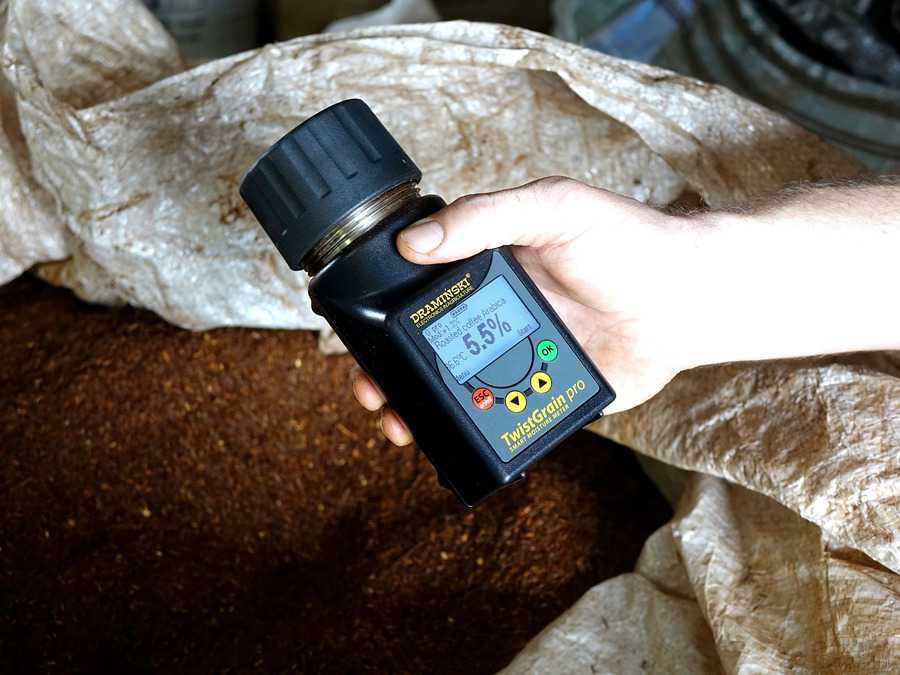
Even well-harvested rooibos can lose quality if these steps are not carried out with care. On the other hand, controlled storage can help aromas become more complex and better balanced. Before storage, rooibos is dried to a residual moisture content of below 8 %; under controlled conditions, a longer resting period can further support the maturation of the material.
Added to this is the signature of the respective producer. Which raw material is selected, how it is processed, cut, blended or further developed all shape the style of the final product. Rooibos therefore reflects not only the plant itself, but also the decisions of the people who turn it into a specific tea.
Why rooibos works so well as a base for blends
One of rooibos’s particular strengths becomes clear in blends. It not only brings its own aroma, but can also carry and connect other ingredients in terms of flavour. Herbs, spices, flowers or fruits often feel rounder, softer and more harmonious on a rooibos base than one might expect at first.
Rooibos often provides a warm, calm base character. As a result, blends do not feel sharp or restless, but integrated and well balanced. That is part of what makes rooibos so special: it complements other aromas without immediately covering them up.
This also explains why many South African producers work with their own blends and flavour compositions. Rooibos is especially well suited to bringing different ingredients together into one coherent flavour idea.
What to pay attention to when tasting
Anyone who wants to drink rooibos more consciously does not need to master technical language. Often it is enough to pay attention to a few simple questions:
- Does the rooibos feel soft and rounded, or rather dry and strong?
- Does it remind you more of honey, caramel, herbs, flowers or fruit?
- Does the flavour feel clear and well balanced, or rather dull and uneven?
- Does the blend have a calm, coherent effect, or does it feel more sharp and unsettled?
Even with just these few questions, differences can often be noticed surprisingly well. That is exactly what makes rooibos not more complicated, but more interesting.
Understanding rooibos more consciously
Rooibos is not a tea that can be thought of in only one direction. Its flavour range extends from soft and honey-like to fuller, drier and more distinctive. Cut grade, preparation, origin and processing often influence this impression more strongly than many people first assume.
Those who taste rooibos more consciously begin over time not only to recognise differences between individual products, but also to understand why some teas feel more familiar while others show more depth, more individuality or more structure.