



Carmién Tea – Rooibos & blends from Citrusdal (Cederberg)
Carmién in numbers
- Company: Carmién Tea (Pty) Ltd, founded 1999
- Location: Western Cape (South Africa) – Citrusdal / Cederberg · Processing: Bergendal Rooibos
- 🗺️ Location on the map: Google Maps · Apple Maps · OpenStreetMap
- Main products: Rooibos (classic & green rooibos) · Rooibos blends & specialties (e.g., cold brew, espresso variants)
- Highlight 1: Consistent taste through controlled blending of different batches (visible in your photo series)
- Highlight 2: Pasteurisation and lab samples as fixed steps – for hygienic stability and consistently high quality
- People: Mientjie Mouton (Founder & Managing Director) · Lieschke van Zyl (Key Account Manager) · On-site team in Citrusdal
More details (quick explanation)
What you understand particularly well at Carmién:
Rooibos is a natural product – and yet one variety can taste very similar throughout the year. The key is the process: sorting, blending, direct transfer into pasteurisation, subsequent separation (incl. rooibos dust/fines), and verification via lab samples.
Processing on site:
Your images show steps customers rarely get to see: from the vibrating sieve (coarse/fine), to the blending system with a conveyor belt into pasteurisation, all the way to filling and packaging.
Range & audiences:
Carmién takes rooibos a long way – with product worlds for different needs (classic, wellness, family/kids, cold brew/iced) and a wide selection of blends and formats.
LMC line:
LMC (Lize Mouton Collection) is a dedicated, curated line within the Carmién world – focused on special blends, enjoyment, and gifting.
Carmién products in our shop
Our range grows step by step: If you’re missing a specific variety or line from Carmién, feel free to message us — and we’ll see what we can make possible.
Carmién online:
Carmién in 8 pictures
Source des images : Carmién Tea / Bergendal Rooibos
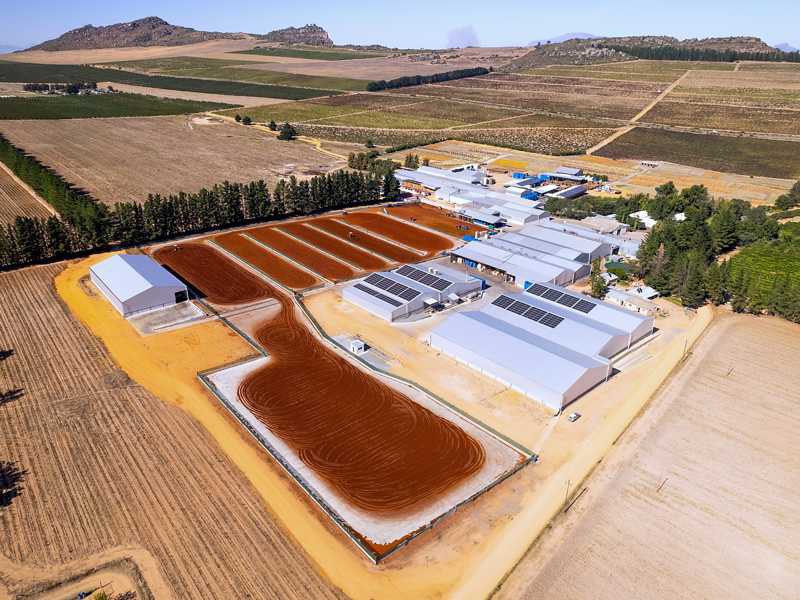
This is where Rooibos becomes Carmién
From above, it becomes clear how closely the tea courts and further processing at Carmién are connected. The later Carmién teas do not begin somewhere abstractly in South Africa, but in a clearly defined place with clearly structured steps.
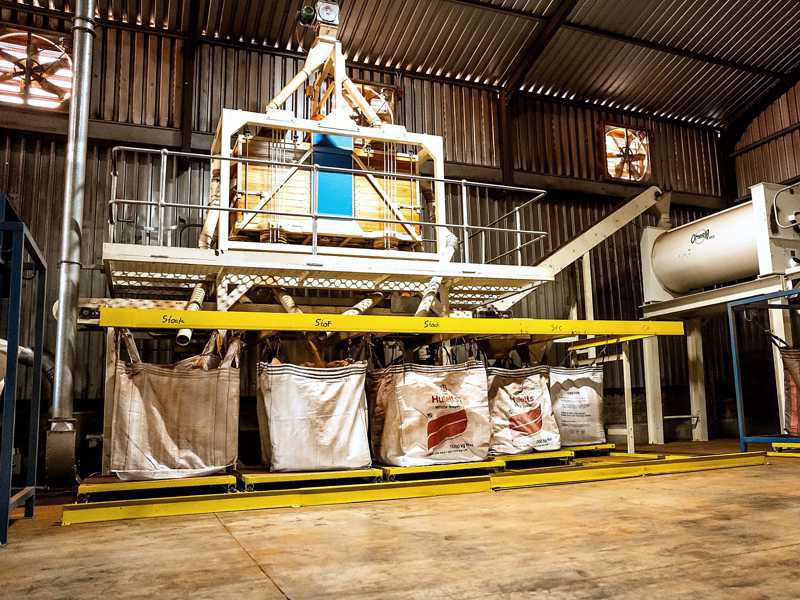
Coarse and fine: why particle size matters
In the vibrating sieve system, the dried rooibos is separated by particle size. It is a technical step, but one that later has a great deal to do with how a rooibos looks, how it is processed and how it performs in the cup.
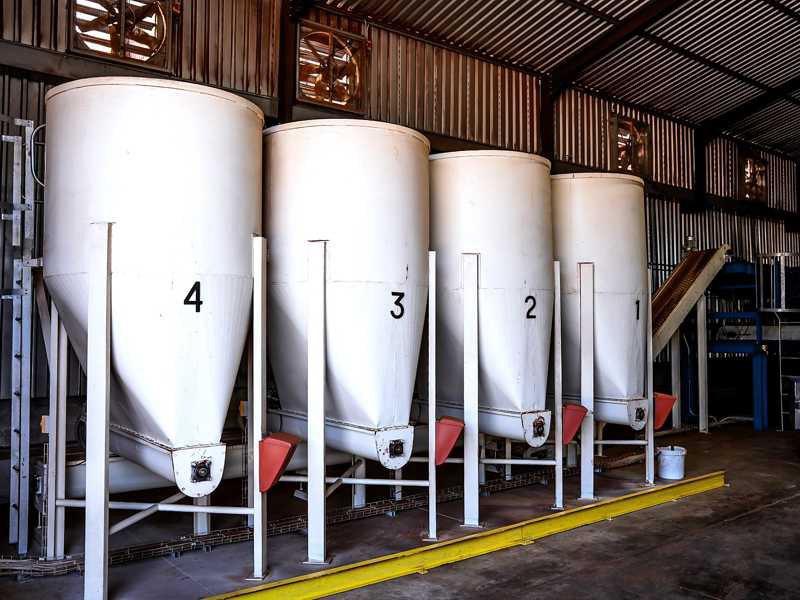
Blending: so your tea tastes the same every time
Rooibos is a natural product and no two batches taste exactly the same. In the blending silos, different lots are combined so that the typical Carmién character remains recognisable throughout the year.
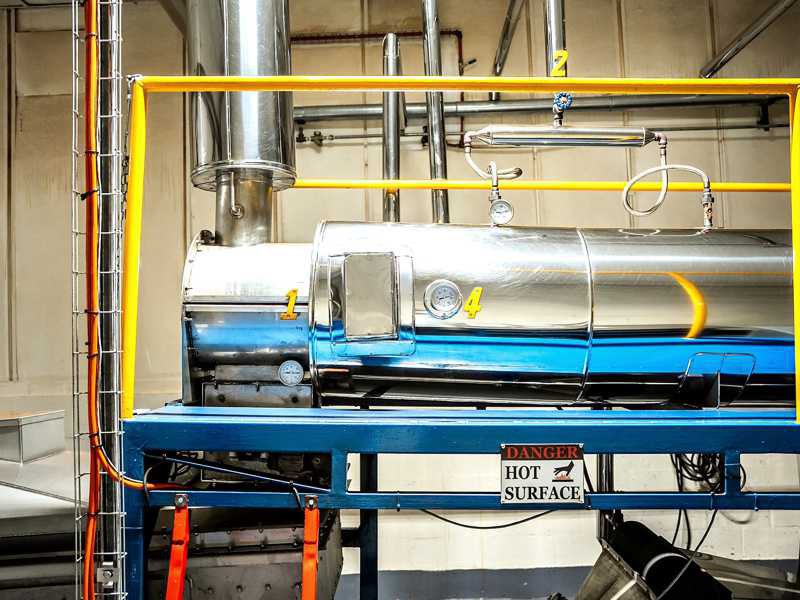
Gently stabilised: pasteurisation as a control step
Here, rooibos is pasteurised with hot steam. This step is a fixed part of Carmién’s controlled processing and ensures that the tea moves on to the next stages in a hygienically stable condition.
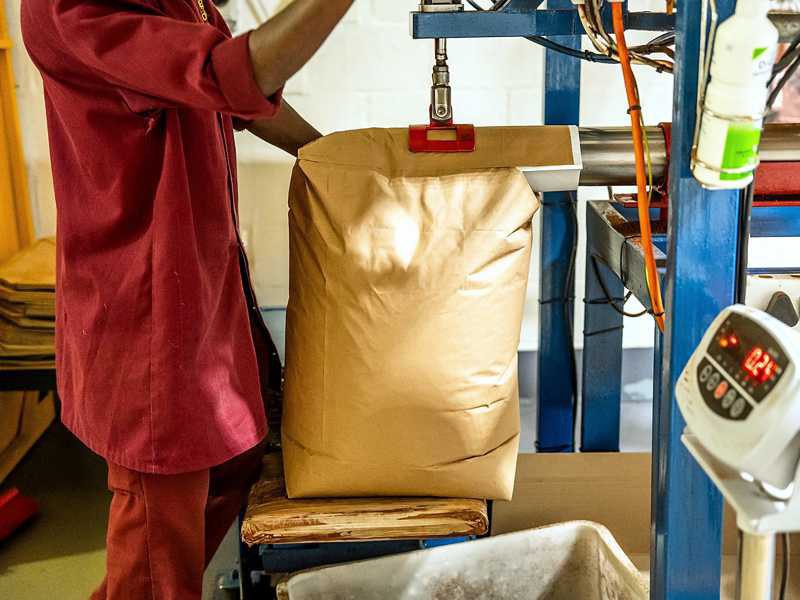
Filling after pasteurisation
After pasteurisation, the rooibos is filled, weighed and labelled. This image makes the process especially easy to grasp, because it shows how loose material becomes a clearly managed production step.
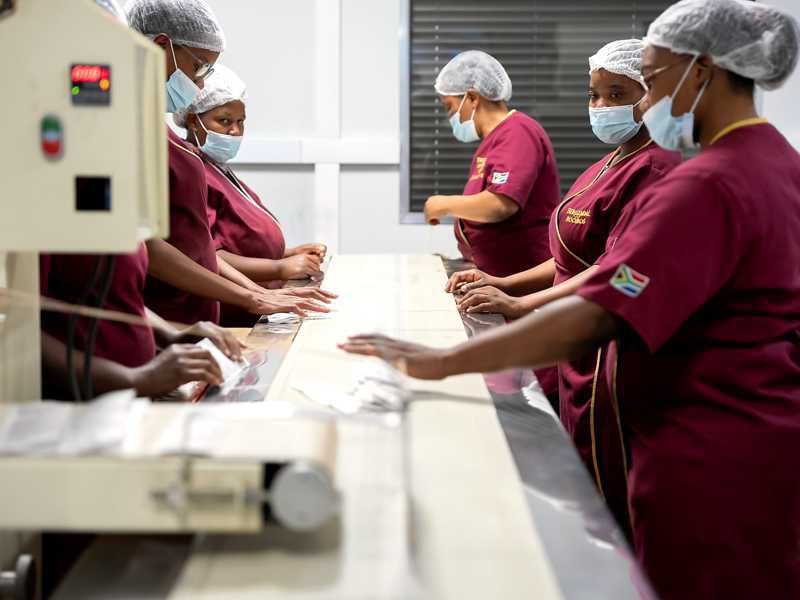
From processed rooibos to tea bag
Here you can see how processed rooibos becomes a concrete final product. The tea bags come out of the machine and are taken on to the next step before going into the retail packs.
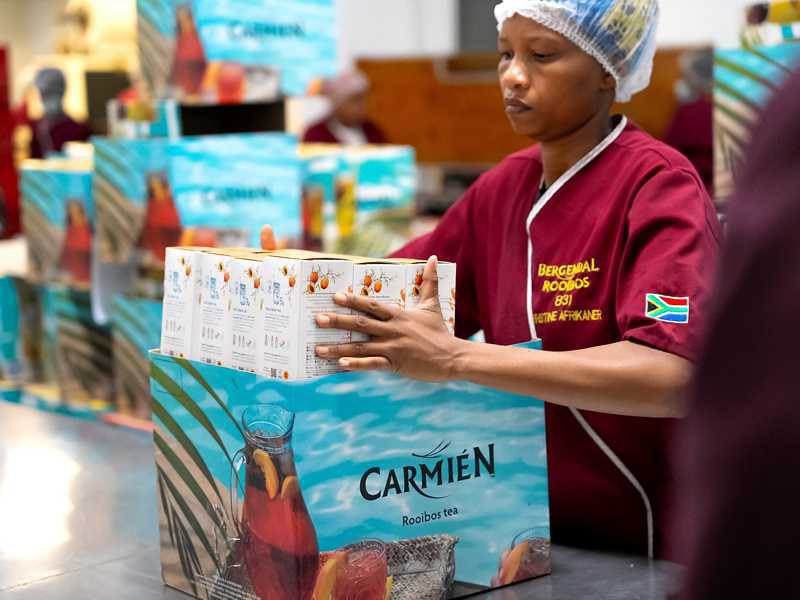
Packed and ready for shipping
At the end of the line, it is not only about machinery, but also about manual work. The finished Carmién teas are prepared for shipping and carried forward as clean, controlled goods.
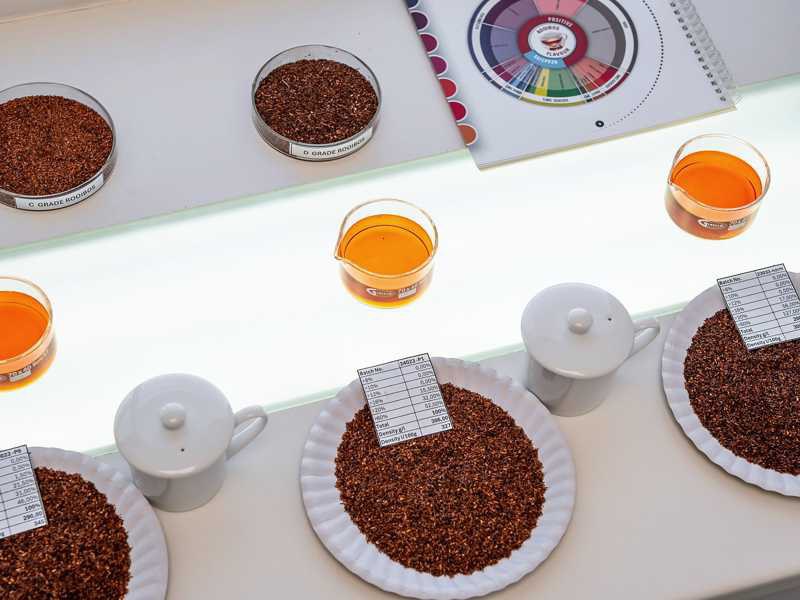
Quality that is not just claimed
In the laboratory, rooibos is not only inspected visually, but also evaluated sensorially. Cut, liquor colour and flavour profile are compared so that quality at Carmién can be checked in a way that is clear and traceable.
Citrusdal & Cederberg: why Carmién made me realise how big rooibos can really be
The first impulse came from a South African acquaintance who has lived in the Netherlands for over 20 years. He used to be responsible for Carmién’s key-account sales in Europe. And then — completely unexpectedly for me — he reinvented himself again three years ago: today he leads key-account sales (especially in Germany) for Piekenierskloof Wines. That’s exactly why he told me back then: “If you really want to understand rooibos, go there.”
So on March 8, 2022, I stood in the Carmién Tea Shop on the N7 shortly before the Piekenierskloof Pass — and honestly, I was overwhelmed. Not because “there were many varieties” on the shelf, but because the range is so clearly designed for different people and situations. Besides classic rooibos, there are dedicated lines like Women’s Teas, Wellness Teas or Kiddies Teas, plus infusions, green rooibos — and even things you would hardly associate with rooibos in Europe: Rooibos Espresso or Instant Rooibos. And then there’s the “cold” world: cold brew, sparkling iced teas, cordials — all the way to rooibos distilled gin.
That’s when I realised what Carmién does differently: rooibos here isn’t just a hot drink, but a product consciously developed for different target groups — from everyday tea to “something special”. A great example is the LMC line — the Lize Mouton Collection. Behind LMC is Lize du Preez (née Mouton), the daughter of Mientjie Mouton. It’s a premium line, designed in 2018, with a strong focus on special blends, enjoyment and gifting — you can see a different signature without losing the rooibos roots.
Because the Bergendal facility isn’t far away, I drove on spontaneously that day. And yes — I ended up in the office without an appointment. Seven faces looked at me, understandably. I briefly explained that I was building a rooibos shop in Germany and wanted to introduce myself. One team member kindly asked me to use the official entrance — and that’s where we really started talking. Meanwhile, there was a woman in the room who initially just listened. When I mentioned my acquaintance’s name, she became attentive — and only afterwards did I realise: that’s Mientjie Mouton, founder and Managing Director of Carmién Tea. That’s how the photo came about where she holds a cup in one hand and the teapot in the other.
I got a tour in 2022, but I wasn’t allowed to take my own photos. Later, I was sent images — but they were exactly the kind of “marketing photos” you could (exaggerating a bit) also see on many other sites. Before my next visit on December 4, 2025, I therefore contacted Lieschke van Zyl (Key Account Manager) in advance and explained why I needed real, original photos — not for advertising, but to show people how rooibos is actually made.
When I returned on December 4, 2025, the surprise came: I was suddenly allowed to photograph as much as I wanted. Lieschke and a colleague from the team guided me through processing — and that’s where the photos on this page come from: sorting (coarse/fine), blending different batches for a consistent taste, the conveyor belt directly into pasteurisation, the subsequent separation (where rooibos dust is also removed), and finally the quality control in the lab. For me, that was the moment when “rooibos” no longer felt like anonymous tea bags, but like a well-managed process with many hands behind it.
And because in Citrusdal rooibos, citrus and wine-growing naturally belong together, the circle closes for me too: through the connection via my acquaintance and the region, I plan to add selected wines from Piekenierskloof Wines to the shop in the future — as a complement, not a distraction. Rooibos remains the centre. But anyone who has been there understands: this region can do more than just “tea”.