



More about Cancer Bush
Why is this plant actually called Cancer Bush?
More about Cancer Bush
The names “Cancer Bush”, “Krebsbusch” and “kankerbos” are among the South African names that refer to the traditional use of this plant. Other names, such as balloon pea, blaasbossie or blaas-ertjie, point instead to its form: to fruiting bodies surrounded by a balloon-like casing. This alone shows that the plant has been perceived in very different ways — through its traditional use as well as through its striking appearance.
This traditional use also included collecting the plant for household needs. Families gathered Cancer Bush in dry scrub landscapes not for its taste, but because the plant was regarded as a household and medicinal plant and used for infusions and other simple applications. The fact that this practice still leaves traces in some regions can also be seen in the way Cancer Bush is still often wild-harvested and traditionally used in South Africa today.
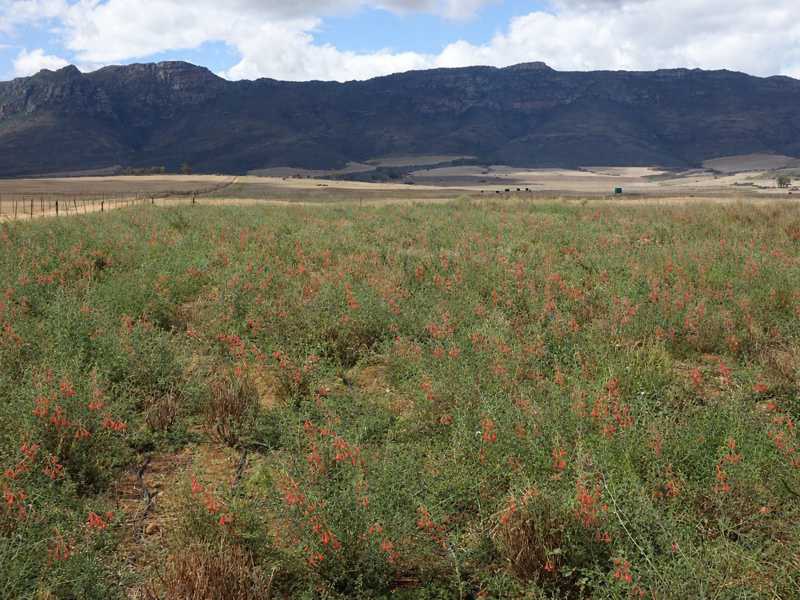
A flowering field of Cancer Bush in a dry South African scrub landscape. The image places the plant in the landscape from which its traditional use emerged.
Not a gentle introduction, but a bitter character
In taste, too, Cancer Bush is different from Rooibos or Honeybush. The first impression is not soft or sweetish, but a plant with a distinctly bitter character rich in bitter compounds. Even the silvery-looking leaves, the red flowers and the balloon-like fruiting bodies make it clear that this is not about an easy everyday tea.
That is precisely why the approach to Cancer Bush is usually slower. You do not approach this plant through mildness, but through its bitter character.

In some farm families, chilled Cancer Bush infusion is part of everyday life. When drunk cold, it tastes less bitter than when served hot.
Two botanical names for the same plant
In everyday language, and also in product-related contexts, we usually encounter Cancer Bush as Sutherlandia frutescens. In more botanical or science-oriented texts, however, the name Lessertia frutescens appears more often. Both refer to the same plant.
The name Lessertia frutescens goes back to a botanical reclassification published in 2000 by Goldblatt and J. C. Manning. This did not give the plant a new everyday name, but above all a different botanical classification.
Where to go from here
Those who would like to discover Cancer Bush further from here can follow two paths. They can go deeper into origin, tradition and botanical classification. Or they can look directly at today’s product forms.
In the shop, Cancer Bush appears today in different forms. From here, everyone can choose the approach that suits them best.